


Let’s talk childminding FAQs
What is the consultation about?
Childminding Services Regulations were introduced in 2024.
These regulations provide important safeguards for children and assurances for parents. Tusla manage the registration for childminders. There is a transition period, up to September 2027, after which registration is due to become mandatory.
The Department of Children, Disability and Equality are currently reviewing the Childminding Services Regulations to understand how they are working in practice. As part of the review, childminders, parents, families, support organisations and others with an interest in childminding are being invited to share their experiences and views.
What is a childminder?
A childminder is a person who runs a childminding service and is paid to look after one or more children (under the age of 15 years) for at least 2 hours per day, in the childminder’s own home. Childminders work by themselves and do not employ any other people to assist them with the children they are caring for.
You are not a childminder, if you care for children in the children’s own home (such as nannies and au pairs).
What is a childminding service?
A ‘childminding service’ is defined by the Childcare Amendment Act 2024 as a service that:
(a) entails an individual taking care, by himself or herself, of children under the age of 15 years, in the home of the individual, and
(b) is provided to children (other than that individual’s own children) for a total period of not less than 2 hours per day.
Why have regulations been introduced?
The National Action Plan for Childminding 2021-2028 set out a plan to introduce regulation for childminding services. Childminders provide an essential service, and it is important that they are supported and recognised for the important work that they do.
Under the new regulations, childminders who apply to register with Tusla must complete pre-registration training and meet several requirements, including Garda vetting, insurance, first aid certification, and child safeguarding training. All of which are important in keeping children safe.
The National Action Plan for Childminding also aims to make financial support through the National Childcare Scheme (NCS) available to more families who use childminders. The National Childcare Scheme is only available through Tusla-registered childminders. Where childminders are registered with Tusla and has signed up to the National Childcare Scheme, parents may be eligible for subsidies to reduce the fees they pay.
When will the regulations come into effect?
The childminding-specific Regulations were introduced in 2024; they included a transition period. Registration is expected to become mandatory by September 2027.
Who do the regulations apply to?
The regulations apply to all childminders, running a childminding service, that are paid to look after one or more children (under the age of 15 years) for at least 2 hours per day, in the childminder’s own home. The regulations do not apply to those who are looking after children in the children’s own home (e.g. nannies and au pairs), or those looking after close relatives (e.g. my grandchildren/nieces’/nephews)
How were the regulations developed?
The childminding-specific Regulations are designed to suit the home and family setting in which childminders work. The regulations are very different to the regulations for centre-based childcare.
Childminders were consulted on and involved in all aspects of the development of the regulations. Both the Steering Group for the National Action Plan for Childminding, and the Advisory Groups that have supported it, have included childminders, as well as representatives of Childminding Ireland.
In addition, an independent external review of the draft Childminding Regulations was carried out by Dr Bill Maxwell, the former CEO of Education Scotland, former Chief Inspector in both Scotland and Wales, and OECD consultant, which confirmed that the approach was proportionate for childminding in Ireland.
The Department of Children, Disability and Equality are now reviewing the Childminding Services Regulations to understand how they are working in practice. The review will also look at the supports that are available for childminders, and anything that may be holding childminders back from registering.
To find out more and explore the background to the childminding regulations go to: National Action Plan for Childminding 2021 - 2028
What is Registration?
In September 2024, childminder-specific regulations were introduced.
The regulations provide minimum standards for childcare provided by childminders in the home and family setting. These regulations provide important safeguards for children and offer safety and quality assurance for parents. Tusla manage the registration of childminders. There is a transition period, up to September 2027, after which registration is due to become mandatory.
During the transition period childminders can register with Tusla but they are not required to do so.
To register as a childminder, you must:
- Be at least 18 years old.
- Work alone.
- Care for children in your own home.
- Be paid by the parents of the children you mind.
- Comply with the childminding regulations.
- Be self-employed or registered as a business.
- Care for a maximum of 6 children at any one time. This number includes your own children under the age of 10 when you are caring for them.
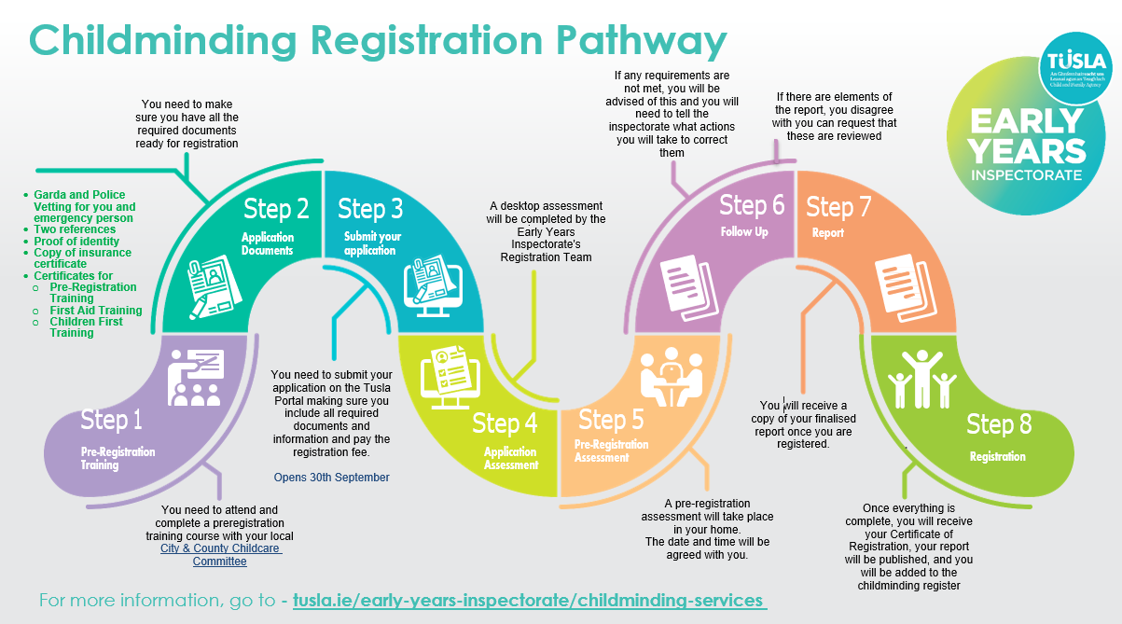
Further information on the registration process can be found here: I would like to register a as a childminder
I only look after close relatives (e.g. my grandchild/nieces/ nephews) - Do I have to register as a childminder?
If you are only caring for close relatives, then you will not have to register as a childminder. However, if you are childminding as a business and you are being paid by the children’s parents then you can register with Tusla, but you do not have to. If you choose to register with Tusla then you will be able to take part in the National Childcare Scheme, and you will be subject to the childminding regulations. The National Childcare Scheme subsidises parents’ childcare costs. The National Childcare Scheme is only available to Tusla-registered services.
How many children can I mind?
- As a childminder you can mind no more than 6 children at any one time, including your own children under 10 years of age. Once your child reaches 10 years of age, they are no longer counted in your numbers.
- Of those 6 children, you can mind 2 children under the age of 15 months at any given time (except in the case of siblings)
I have more than 6 children availing of my service, is this okay?
Yes. You may have more than 6 children availing of your service some of whom may be attending on a part-time basic therefore you may have more than 6 children on your attendance records. It is important to remember that the maximum number of children you can mind is 6 at any one time.
I am minding more than 6 children at one time, am I a childminder?
If you choose to mind more than 6 children at any one time you are not a childminder. You must register as an Early Years Pre-School or a School Aged Service. Additional requirements will apply. For more information see Tusla Early Years Inspectorate.
What is the National Childcare scheme, and can I offer it to the families who use my service?
The National Childcare Scheme subsidises parents’ childcare costs. It is only available to Tusla-registered services. Once successfully registered with Tusla, childminders can sign up to the National Childcare Scheme. They can then offer subsidised childcare places to the families that use their service.
For more information see The National Childcare Scheme
What is the National Action Plan for Childminding?
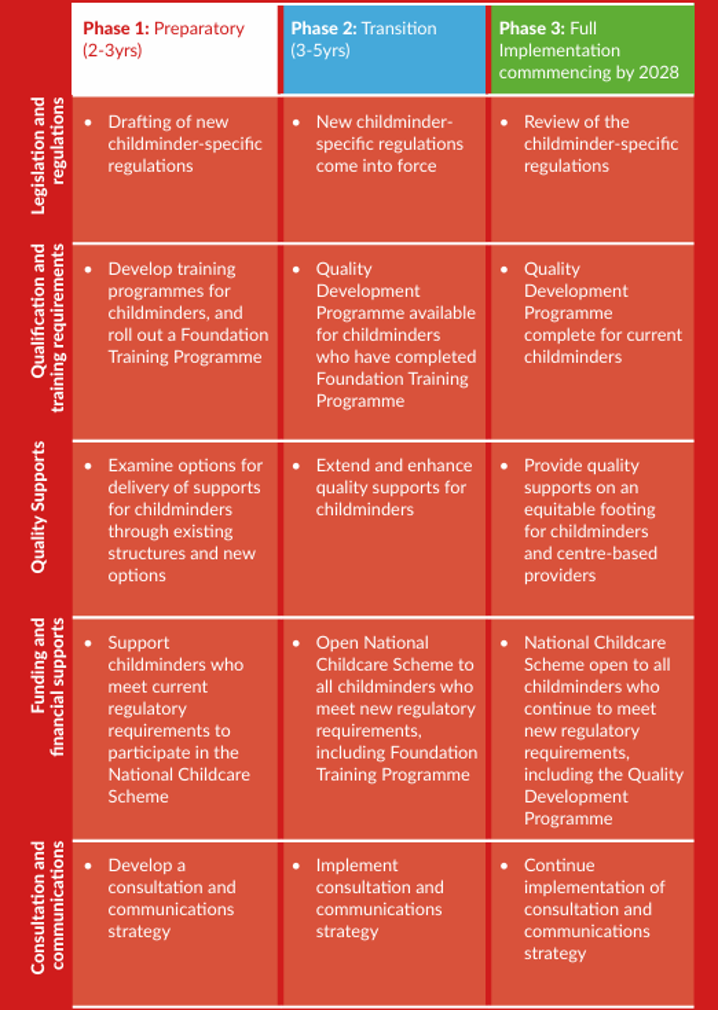
The National Action Plan for Childminding 2021-2028 set out steps towards regulation, support and subsidies, for all childminders.
The action plan sets out a pathway to regulation enabling childminders access to support to assist with meeting regulatory, quality and training requirements along with access to government subsidies.
National Action Plan for Childminding Pathway:
For more information see National Action Plan for Childminding 2021 - 2028
What changes have happened following the introduction of the National Action Plan for Childminding?
Dedicated Childminding Supports:
The National Actional Plan for Childminding introduced dedicated Childminding Development Officers (CMDOs) in every City and County Childcare Committee (CCC).
CMDOs provide:
- One to one support throughout the registration process
- Information and guidance on regulations
- Pre-registration supports
- Access to training opportunities
- Information on grants and funding
- Networking opportunities with other childminders
The Childminding Development Officers are there to provide the most up-to-date, accurate information, and to guide and support childminders at every step of the journey.
Childminding Specific Regulations:
The childminding-specific Regulations are designed to suit the home and family setting in which childminders work. The regulations are different to the regulations for centre-based childcare.
The Child Care Act 1991 (Early Years Services) (Childminding Services) Regulations 2024
From 30th of September 2027, it will be a statutory requirement that all childminding services in operation are registered with Tusla.
Pre-Registration Training:
To register as a childminder with Tusla you must complete the Pre-Registration Training with your local City/County Childcare Committee.
Access to the National Childcare Scheme (NCS):
Once registered with Tusla, you can apply to become an approved provider under the National Childcare Scheme (NCS).
This allows eligible families using your service to apply for Government childcare subsidies.
What is the Childminding Pre-Registration Training Programme?
The Childminding Pre-Registration Training is a mandatory course for anyone who intends to register a childminding service with Tusla. This free training will support you to understand the new childminding regulations and will provide you with all the information required to register with Tusla.
How long does the Pre-Registration Training Programme take?
This training takes approx. 6 hours to complete. This training is offered by your local City/County Childcare Committee. There is no assessment, and you will be issued a certificate upon completion.
What do I need to register with Tusla?
You will need the following:
- Garda Vetting & Police clearance for the childminder & emergency cover person/s
- Two written references
- Proof of identity
- Appropriate insurance certificate
- Certificates for Pre-Registration Training, First Aid training and Children First E-Learning.
Further information on the registration process can be found here: I would like to register a as a childminder
When do I need to register?
All childminders must be registered by 30th Sept 2027. To ensure you meet this deadline, it is advisable that you start this process as soon as possible to avoid any delays. It is also important to note that Tusla require 3-months to process completed applications, as outlined in the regulations.
Further information on the registration process can be found here: I would like to register a as a childminder
Remember:
If you're already Tusla registered: There is no immediate change. Continue to meet your registration requirements and keep up to date with any future changes.
If you are an unregistered childminder: You have until 30th September 2027 to register if you wish to continue operating as a childminding service.
If you are thinking about becoming a childminder: Dedicated supports and training are available to help you through the registration process.
For further information, support and training and to avail of national updates, contact your local Childminding Development Officer in your City/County Childcare Committee.
Where can I find Support?
The National Actional Plan for Childminding introduced dedicated Childminding Development Officers (CMDOs) in every City and County Childcare Committee (CCC).
CMDOs provide:
- One to one support throughout the registration process
- Information and guidance on regulations
- Pre-registration supports
- Access to training opportunities
- Information on grants and funding
- Networking opportunities with other childminders
The Childminding Development Officers are there to provide the most up-to-date, accurate information, and to guide and support childminders at every step of the journey.
I have a question that is not answered here - who can I contact?
If you have a question about childminding or the review of the Childminding Services Regulations, you can email the Department at qualitydevelopment@dcde.gov.ie